Distribution Communications Protocol
The aim of the following text is to explain what EDI (Encapsulated DAB Interface) entails.
In fact, EDI is simply an application of the generic DCP/TAG mechanism or DCP protocol.
In the text below, we frequently use the word ‘packaging’. The technical term for this is ‘encapsulation’.
The Distribution and Communication Protocol (DCP) is a general-purpose protocol that describes how data is logically packaged and structured. DCP is not, in itself, tied to any specific application (it is application-independent). It merely defines the way in which data is organised, but does not specify exactly what that data should be.
EDI (ETI Distribution Interface) then describes how DCP is used to transmit ETI information over IP networks. In other words, EDI uses DCP as a building block and specifies which TAGs (packaging boxes) are to be used and how they should be filled in.
ETI was originally designed for stable serial connections between an ensemble multiplexer (MUX) and a DAB transmitter. However, this format is less suitable for transmission over IP networks.
For this reason, the information from an ETI-LI frame is repackaged using the DCP protocol in accordance with the prescribed EDI rules.
Instead of sending the entire ETI-LI frame as a single large data block, the information is split into several logical data blocks. Each block is encapsulated in a TAG (the proverbial box).
For example, there is a TAG (box) called DETI, this box contains general information about the ETI-LI frame, such as the frame parameters and the synchronisation data TIST, TAI and UTCO (UTC Offset).
In addition, there is a separate ESTn-TAG for each sub-channel of the multiplexer, where n represents the sub-channel number. Thus, EST0 contains the data for sub-channel 0, EST1 that for sub-channel 1, and so on.
All TAG items (the small boxes) that together describe a single ETI-LI frame are then combined into a single larger package: the TAG package. This TAG package constitutes the complete description of a single ETI-LI frame.
The TAG packet is then encapsulated in an Application Frame (AF) for transmission over the network. You can think of an AF as a large shipping box into which the entire TAG packet is placed. The AF layer does not recognise the meaning of the individual TAG items; its sole purpose is to ensure that the entire TAG packet can be transmitted securely as a single unit.
The AF (the large box) therefore does not contain the ETI frame itself, but rather the collection of TAGs (packaged boxes) which, taken together, represent all the information contained in that ETI frame.
It is important to note that the content of the ETI information does not change. Only the way in which this information is packaged for transmission over an IP network is different.
When the IP connection is less reliable, an additional layer of encapsulation can be added on top of the AF: PFT (Protection, Fragmentation and Transportation). This layer can split the AF into smaller fragments and, optionally, add Forward Error Correction (FEC), so that a limited number of lost IP packets can be reconstructed.
Finally, all of this is transmitted over the network via the UDP/IP protocol stack.
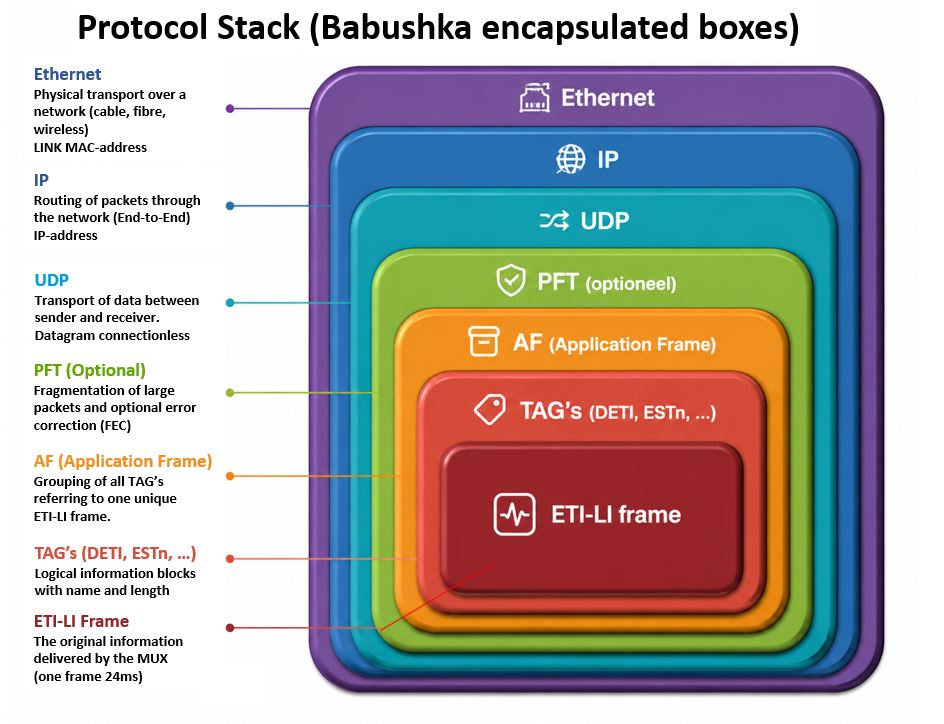
By analogy with Russian babushkas (or matryoshkas), we would like to present the protocol stack as a series of nested boxes, viewed from above. In technical documentation, this is often depicted as a stack of layers, with the smallest box representing the top layer and the bottom box representing the lowest layer (layered model).
In the model below, the physical layer (the lowest layer) is shown together with the link layer (Ethernet). Everything above the UDP box constitutes the application layers. The encapsulation carried out by DCP is found in the application sub-layers: TAGs, AF and the optional PFT layer. It is important to realise that each layer is encapsulated within the layer below it, even when this is depicted vertically (see technical documents).