
The Phase-Locked Loop
In this section, we present one possible operating principle illustrating how a GPS Disciplined Oscillator (GPSDO) can be implemented using a stable 10 MHz GPS frequency reference.
Depending on the manufacturer, many different implementations exist, often considerably more sophisticated than the example presented here. The purpose of this section is therefore not to describe a specific hardware design, but rather to explain the basic operating principle of a PLL in an intuitive way.
As an example, we consider the 16.384 MHz frequency reference used in both the DAB+ ensemble multiplexer and the transmitters. At the heart of the system is a highly stable oscillator (for example, a VCXO or OCXO) whose frequency can be adjusted very precisely by means of a control voltage.
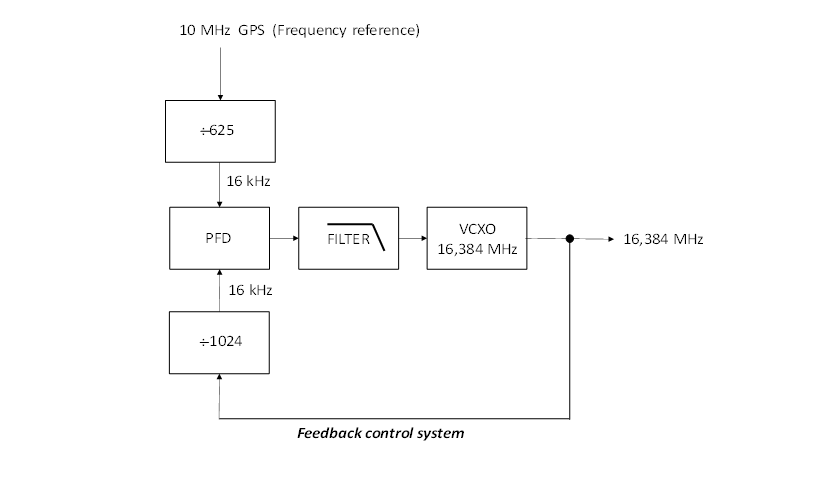
The 10 MHz GPS reference is divided, for example, by 625, producing a frequency of 16 kHz. Likewise, the oscillator output of 16.384 MHz is divided by 1024, resulting in the same 16 kHz frequency.
These two 16 kHz signals are then compared by a Phase Frequency Detector (PFD). The PFD compares both the frequency and the phase of the two signals and generates an error signal whenever a phase or frequency difference is detected.
If the loop filter were omitted, the control loop would operate almost entirely as a proportional controller. In that case, the oscillator would continuously alternate between running slightly too fast and slightly too slow, causing the control loop to oscillate around the desired operating point.
To obtain a stable control loop, a loop filter is inserted between the PFD and the oscillator. In practice, this is typically a low-pass filter with an integrating characteristic. The filter suppresses rapid control corrections and allows the oscillator to be adjusted gradually. As a result, both the frequency and phase errors converge towards zero until a stable operating condition is reached. At this point, the PLL is said to be locked. The circuit shown above illustrates how the 16.384 MHz DAB+ frequency reference is synchronized to the highly stable 10 MHz GPS frequency reference, thereby providing the accurate frequency synchronization required for DAB+ transmission systems.